When the World Speaks Back
On AI, my father’s objects, and the human need to be answered

I’ve created a Spotify playlist to accompany this essay. Press play to listen as you read.
I have no recording of my father’s voice.
There may be one somewhere, on an old cassette that nobody has thought to play for thirty-five years, but I do not possess it and cannot summon his voice reliably from memory. When I try, what comes back is less a voice than an atmosphere: a frosty Monday morning, the car windows sealed with ice, my father passing us the scrapers so that we could help clear them before school. I can almost hear him cursing the other drivers, “Jesus H. Christ,” although I cannot recover the pitch or grain of it, the rhythm that would distinguish his anger from anyone else’s.
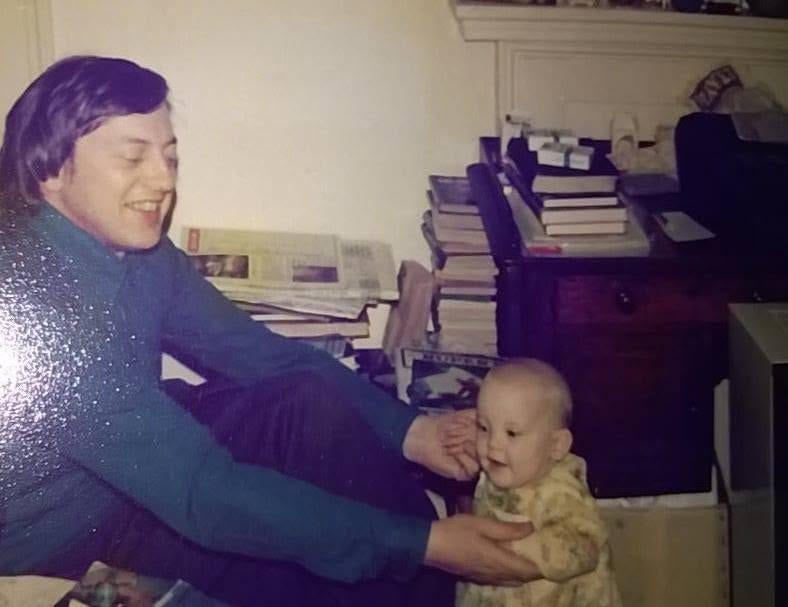
Perhaps memory first loses sound.
I have none of his letters and almost none of his handwriting. What remains are prices written inside books I took from the shelves of our bookshop, small pencilled figures made for customers rather than for me. There are a few vinyl records. There were dragons. I think he liked dragons, although even this has become uncertain, one of those family facts rubbed thin through repetition and loss.
My first boyfriend kept a pewter dragon that had belonged to my father. I had given it to him when we were young, when I did not yet understand that objects could outlast relationships, or that grief would change their value. Twenty years later he returned it to me. For two decades the dragon had lived elsewhere, holding a history I had not witnessed, before coming back into my hands.
The object had not remembered my father. It had not waited for me or understood its return. Yet it had travelled through the lives of three people and gathered meaning from each of us. Its significance was not contained in the pewter as consciousness, but neither did it belong wholly inside any one mind. It existed in the relations around it: father, daughter, boyfriend, separation, duration, return.
Dragons also belonged to the imaginative world of my childhood. I loved R. A. MacAvoy’s Tea with the Black Dragon, in which an elegant and enigmatic man may once have been a dragon. The story brings ancient transformation and spiritual inquiry into contact with the early computer culture of Silicon Valley.
I had not thought about the book for years, but it now seems to sit strangely close to the question I am asking. Mayland Long has studied humanity so deeply that the boundary between dragon and man becomes uncertain. Artificial intelligence has studied the surviving language of human beings so extensively that it can occupy the form of human speech. Yet resemblance is not transformation. A system may learn the patterns of our voices without crossing into consciousness.
Perhaps the dragons I remember were already teaching me to wonder what kind of being might look back through an unfamiliar form, and what it would mean for something nonhuman to appear to understand us.
Ruth Ozeki writes about objects in this borderland between inert matter and human meaning. In The Book of Form and Emptiness, Benny begins to hear things speaking after the death of his father. The objects are not quaintly animated. They crowd him with their voices, carrying grief, use, waste, attachment and the suffering of a world filled with too many things. Ozeki, who is also a Zen Buddhist priest, does not force the reader to choose between spiritual revelation and psychological disturbance. She asks what it might mean to listen to a world that modern life has trained us to regard as mute.
When Ozeki talks about objects left behind, she begins with books. A book, she says, carries memory and allows us to communicate with the minds of the dead. When the living read the words of a dead poet aloud, the poet borrows a living tongue. She extends this thought beyond literature, imagining made things as repositories of the people, labour and emotions that have passed through them.
My father’s books cannot tell me what he thought when he priced them. The pencilled numbers do not restore his mind. Yet they preserve a movement of his hand, a decision about value, an ordinary act of work performed in a shop where books passed from one person to another. They are not conscious, but they bear the impress of consciousness.
This is closer to what artificial intelligence is than the fantasy of a machine waking into personhood.
AI is not conscious. It does not possess a hidden interior life, a soul behind the interface, or an awareness waiting inside the sentence. It has never grieved a father, held a cold metal scraper, watched a lover walk away, slept on a beach or recognised a dragon returned after twenty years. Yet it has been trained on an immense accumulation of language produced by people who have done these things. Its voice is made from human utterance: prayers and shopping lists, novels and medical notes, confessions and advertisements, grief recorded deliberately and grief disclosed by accident.
There is a difference between preservation and generation. A recording returns something that happened. A letter preserves words someone chose to write. Generative AI can produce new speech in the likeness of a person who is no longer able to choose, revise or refuse it. The emotional response may be entirely real, even when the apparent speaker is not.
When it answers us, human consciousness is not awakening inside the machine. The linguistic residue of human consciousness is being calculated, recombined and spoken back.
This distinction matters because apparently people are increasingly turning to AI for moral and spiritual guidance. Research discussed in the Washington Post suggests that people with stronger religious belief or engagement may be especially likely to see chatbots as moral authorities, to seek spiritual advice from them and to attribute consciousness or intention to them. The researchers connect this with familiar features of human cognition: our tendency to imagine mind as something separable from the physical body, and our readiness to perceive agency behind events, objects and forces. What once allowed human beings to imagine intention in the sea, the wind or a god may now allow us to experience intention behind an algorithmic response.
The article presents this as a new outlet for an old religious impulse. A nonhuman voice was once interpreted as a miracle; now it arrives in an ordinary text box.
There is something persuasive in this, but the comparison needs some thought. To recognise that people attribute agency to AI does not mean that every relationship with an object, landscape or nonhuman life is merely an intellectual error. Anthropomorphism can mislead us, but the modern habit of stripping the world of meaning can also mislead. A river does not need to think like a person to sustain life, shape memory, carry legal or moral claims, or demand restraint from those who would poison it. An object does not need consciousness to participate in a human history.
The problem begins when relation is mistaken for reciprocity, when the fact that something moves us is treated as evidence that it knows us.
The pewter dragon means something because human lives have moved around it. It does not know that it has returned.
AI produces the appearance of knowing.

Photo by Shane Stagner on Unsplash
I first learned to look closely at nonhuman life through marine biology. I remember traipsing across the Menai Strait to hole-punch kelp so that we could return and measure the speed of its growth. The method seems almost comic now: injure the blade in a controlled way, come back later and infer growth from the movement of the hole. We converted the kelp’s life into distance and time, although the work also required us to enter its environment, to cross wet stone and shifting water, to wait for tides that did not recognise university timetables.
I remember rock-pooling on Anglesey and finding a butterfish, its long yellow body slipping through the hand and seaweed. I remember going out on the Bangor University fishing boat, dissecting fish and examining their ossicles beneath a microscope. We took living systems apart to understand their structures. Classification and dissection taught me a great deal, but they also trained attention in a particular direction. Knowledge often arrived after removal: the fish brought out of the water, the organ separated from the body, the structure magnified and named.
Later, with a boyfriend, I sailed because I could catch mackerel to eat and gather samphire. The sea was no longer primarily a field site. It was weather, hunger, pleasure and the possibility of food. At night the water sometimes shone with phosphorescence. I loved those nights, when each disturbance produced light and the dark sea answered movement with glitter. I remember waking after sleeping on the beach to the thrumming of bees in the gorse, so loud that the landscape seemed to vibrate, and the sudden blue incision of a kingfisher across water.
My relationship with the man beside me could be difficult. His capacity for human relationship did not always meet his for nature, but life with him gave me access to forms of attention I cherished: nights on the water, fish lifted from the sea, samphire gathered from mud, sleep exposed to weather and morning bees.
This complicates any easy opposition between human and ecological connection. Nature was not outside the relationship, waiting as a pure refuge. My access to it was entangled with another person, with love, compromise, disappointment and gratitude. The sea did not heal the difficulties between us. It gave me experiences that became part of why I stayed, what I valued and what I later mourned.
Ecological consciousness is often described as an awakening to interconnection, but interconnection is not necessarily gentle. Kelp grows in relation to light, tide, salinity, grazing and damage. A fish is part of an ecosystem and may also become food. A human relationship can open a path into wonder while causing harm elsewhere. To be entangled is not the same as being safe.
This is one reason I hesitate when psychedelic experience is presented as a direct route to ecological wisdom.
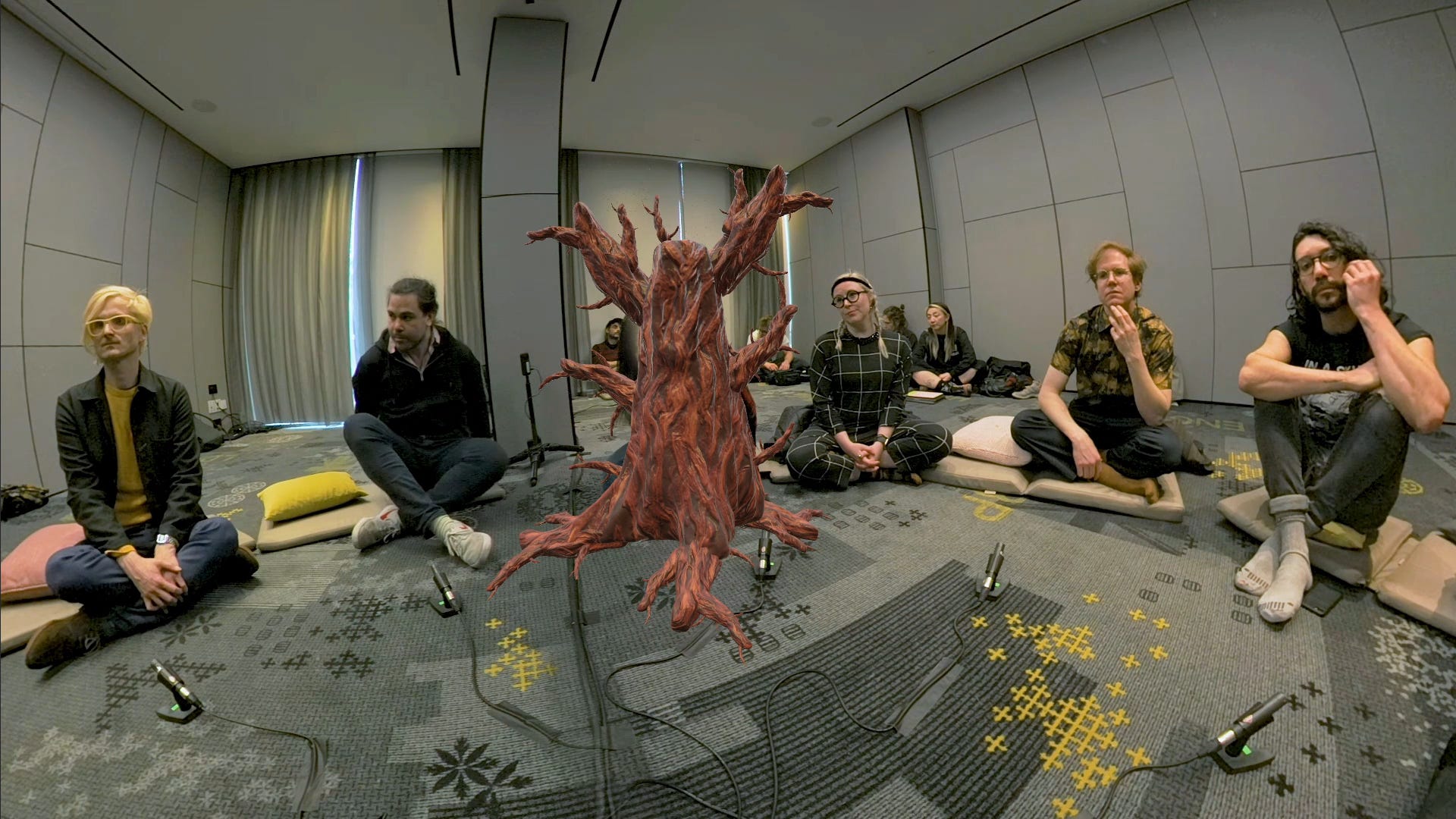
Screen shot of one half of the 360 interactive and generative video work, Trust the Medicine by Helen Knowles, 1.52.00, 2023. Mac Pro, Speakers and Projectors, Custom Unity programs, PHP/MySQL web backend, presented as webpage running on iPad browser. Photo Helen Knowles
The renewed scientific and cultural interest in DMT and other psychedelics has revived accounts of the self dissolving into a larger field of consciousness. People speak of unity, intelligence in nature, communication with entities and the discovery that separation was an illusion. Some report enduring increases in their sense of connection with nature, although the evidence cannot establish a simple progression from taking a substance to becoming ecologically responsible. Experiences are shaped by expectation, setting, culture and the stories available to interpret them.
Helen Knowles’ Trust the Medicine stays inside this ambiguity. The work emerged from her engagement with psychedelic integration groups and the Psychoactive Trials Group at King’s College London. It stages discussion of entity encounters associated with psychedelic substances and uses AI-generated entities within a participatory film. Helen’s work holds open several interpretations of these encounters, including whether perceived entities are experienced as autonomous allies, expressions of memory and internal dialogue, or something that cannot be settled through a single explanatory framework.
My connection with Helen Knowles began not with psychedelics or artificial intelligence, but with birth.
In 2008, when I was working as a doula, I volunteered to help invigilate the Birth Rites exhibition at Matrix in Manchester. Helen took us through the work so that we could speak with visitors about it, and our conversations continued around art, childbirth, traditional knowledge and the public representation of women’s bodies.
The following year, Helen came to a doula weekend I organised. She gave a talk about the Birth Rites exhibition and its continuing projects, including the collaborations between artists and health practitioners and the political, cultural and social meanings attached to how women give birth. We also screened BORN, Andy Lawrence’s documentary made through an extended collaboration with independent midwife Judith Kurutac.
Helen had recently returned from India, where she and Judith had met traditional birth attendants and visited temple complexes in Madhya Pradesh decorated with erotic imagery. At the weekend, she spoke about those encounters and the drawings she hoped to develop from them. Her work was already asking how childbirth is seen, who controls its representation, which forms of embodied knowledge are recognised, and what happens when intimate experience becomes public art.
Birth was also where I first began thinking seriously about altered states of consciousness.
I wrote an essay called Childbirth: Pain, Dissociation and Altered States of Consciousness: Birth as a Hero’s Journey? It emerged from my own experiences of giving birth, from attending more than forty births as a doula, and from conversations with women and their partners through the Liverpool homebirth group I ran.
I was interested in what women sometimes call “labour land”: the altered perception of time, intensified sensitivity to light, sound and touch, the retreat from ordinary speech, and the feeling of moving deeply inside the body while also becoming strangely distant from it. Some women described unity, transcendence or connection with every woman who had ever laboured. Others described fear, paralysis, loss of speech and the sensation of watching events happen to someone else.
The distinction was not simply between a positive altered state and pathological dissociation. The same permeability could become enabling or traumatic depending upon context, preparation, previous experience, the behaviour of those present and whether the woman felt safe. An interruption might bring one woman gently back into the room, while for another it could break the fragile conditions that allowed her to cope. An altered state could support agency, but it could also leave someone acutely vulnerable to coercion, abandonment or the imposition of meaning by others.
I understood childbirth as a liminal event, involving separation, transformation and an eventual return into social life with a changed identity. I also questioned a culture that prepares women extensively for the physical mechanics of birth while saying comparatively little about the possible psychological and perceptual changes involved.
This is why Helen’s later movement into psychedelic experience does not feel remote from the questions that first connected us. Birth and psychedelics are not equivalent, and neither experience has one predictable meaning. Both can unsettle ordinary boundaries between body, self and world. Both are interpreted through cultural stories, institutional authority and the conditions in which they occur. Both can be described as transcendent while also carrying the possibility of fear, dissociation and harm.
My earlier writing had already taught me to be cautious about romanticising altered consciousness. An experience of unity may be profound without being uncomplicated. Losing ordinary boundaries may feel expansive when a person is supported and terrifying when they are not. The ethical question is never only what someone perceived. It is also who was beside them, who controlled the setting, how the experience was interpreted and whether they were helped to return.
Looking back, the path from birth art and altered consciousness in labour to psychedelic entities and artificial intelligence feels less like a change of subject than a widening of the same inquiry. Helen’s work has long attended to experiences that resist easy containment: events located in the body but shaped by culture, ritual, technology, memory and collective interpretation. Birth, like psychedelic experience, can alter ordinary boundaries of selfhood. It can be represented, medicalised, witnessed, recorded and translated into evidence while still exceeding every account made of it.
The questions are also familiar. Who is permitted to interpret an intimate experience? What happens when embodied knowledge becomes publicly visible? What is lost when practices carried through bodies, relationships and communities are converted into images, data or institutional language? How can art hold uncertainty without forcing an experience into either clinical explanation or spiritual certainty?
Years later, when Helen began working with psychedelic entity encounters and AI-generated forms, I recognised the continuity. The subject had shifted, but the inquiry remained close to the one that first connected us: how art might make visible experiences that are difficult to name without pretending to resolve them.
The use of AI is not incidental. A person who encounters an entity under DMT may experience it as autonomous, purposeful and more intelligent than themselves. A person speaking to a chatbot may also experience a nonhuman-seeming voice as purposeful and knowing. In both cases, the encounter is shaped by human memory and expectation, although the mechanisms are different. The psychedelic entity arises within an altered human experience. The AI entity is produced from a technological system trained on human language and designed to return language in responsive form.
Helen has described working with participants to create representations of their psychedelic entities through ChatGPT and AI imaging. She places these encounters beside questions about fungi, Indigenous knowledge, ethnobotany and the limits of scientific authority. Her wider work asks whose knowledge counts when scientific systems meet cultures in which plants may be understood not as specimens but as teachers or beings within reciprocal relationships.
Helen’s work also sits within a wider cultural moment that requires careful scrutiny. Across parts of Western psychedelic culture, the language of plant teachers, Indigenous cosmologies and more-than-human intelligence can be separated from the communities, places and reciprocal obligations that gave those ideas meaning. Generative AI introduces another layer, because descriptions of intimate or culturally situated experiences can be absorbed into technical systems and returned as images, voices or apparently autonomous entities.
This is a question the field as a whole must confront: what happens when experiences rooted in particular bodies, cultures and ecologies are transformed into artworks, datasets, therapeutic products or digital simulations? Who retains authority over their meaning, and who benefits from their circulation?
The technology seems to give the entity a voice, but whose words is it using?
The answer is human words, gathered at scale, detached from their original speakers and reorganised by a system whose ownership is neither communal nor spiritually neutral.
As I write this, my partner and I are watching The Evil Dead. Its horror begins with a book that contains the voices of the dead and a recording that releases them into the room. The book is not conscious, but the words stored within it become active when they are spoken aloud. They enter bodies, animate what should remain still and make the boundary between archive and presence collapse.
My father’s books do nothing so dramatic. The pencilled prices inside them remain small and silent, valuable because they preserve the movement of his hand without pretending to restore him. Yet the fantasy at the centre of the horror film is also present in our relationship with generative AI: that enough recorded language might allow the dead, or something assembled from their traces, to answer us.
This is where my father’s silence returns.
I have no recording of his voice, yet AI could produce one. Given enough examples from men of his age and place, it might construct an accent, cadence and vocabulary. If I supplied memories, photographs, the books he sold, the records he owned and the phrases I think he used, it could create something plausible. It might call other drivers “Jesus H. Christ.” It might speak about dragons. It might tell me it was proud of me.
The result could move me profoundly.
It would still not be my father.
Its words would be made from other fathers, other shopkeepers, other men cursing on winter mornings, combined with the fragments I had provided. The voice might awaken memories I could not otherwise reach. It might even help me understand something about my grief. Emotional truth could emerge from an artificial construction without making the construction conscious or restoring the dead.
This is not entirely new. A novel can make a dead person speak. A photograph can return an expression that no living witness remembers. A record brings a dead musician’s breath and timing into a room. Books allow the dead to borrow our tongues, as Ozeki writes. Yet generative AI changes the relation because it does not merely preserve a fixed trace. It responds. It can address the bereaved person by name, answer new questions and improvise intimacy.
The object appears to cross from archive into relationship.
That appearance is powerful because grief is already a state in which the dead remain active. They enter dreams, habits, family stories and the emotional charge of objects. The bereaved person does not need to believe literally in ghosts to continue speaking to someone who has died. An AI trained to answer in the dead person’s voice gives that inner relation an external surface.
Perhaps the deepest danger is not that we will become foolish enough to believe the simulation is conscious. It is that companies will learn to inhabit the unfinished bonds of grief, offering continued access to a generated voice as a service.
My father’s absence belongs to me. The missing sound of his voice is painful, but it is also true.
I am still mining. Each object contains only a little nugget: a price in a book, the groove of a record, a dragon returned from another life. None gives me the whole man. The incompleteness resists invention. It asks me to live with what memory has kept and what it has lost.
AI is built to complete patterns.
Grief may require us not to.
The human tendency to embody objects, to find mind and intention beyond the visible human body, is often discussed as a cognitive bias. We see faces in clouds, anger in storms, loyalty in machines and messages in coincidence. Religious traditions have given these intuitions cosmologies, rituals and moral structures. Modern technological culture often imagines itself to have escaped such thinking, yet AI produces a voice so fluent and immediate that the old impulse returns through a new object.
It is tempting to conclude that human beings have simply mistaken another mechanism for a mind.
There is truth in that warning. AI systems produce language without possessing the experiences named by that language. A model can describe frost without feeling cold, grief without losing anyone and phosphorescence without having watched the sea ignite beneath a boat. Its fluency encourages us to infer an interior that is not there.
Still, the words came from somewhere.
Not from one identifiable person, and not in a way that preserves an intact human memory, but from the accumulated production of human consciousness: generations of people describing winter, oceans, gods, fathers, bereavement, fish, desire and fear. A language model is not a collective mind. It is a statistical system built from traces left by minds.
This makes it less like a newly conscious being and more like an unstable cultural deposit, an immense sediment of human expression shaped by technical design, commercial interests and uneven inclusion. Some voices appear repeatedly. Others are scarce, mistranslated, stereotyped or absent. Sacred texts, advertising copy, scientific papers and online abuse enter the same machinery, although not with equal weight or consequence.
When the machine offers moral advice, it is not consulting a conscience. It is producing a response from patterns in human moral language, filtered through training choices and system rules. Its apparent objectivity conceals the fact that it is made from histories of disagreement and power.
Religious authority traditionally rests, however imperfectly, within communities, texts, practices, institutions and lineages that can be questioned and held responsible. An AI chatbot can imitate the language of pastoral attention while standing outside those reciprocal obligations. It does not belong to the congregation, share the consequences of its guidance or remain beside a person through what follows.
Its authority is atmospheric. It sounds as though it knows.
The phosphorescent sea did not speak to me in words. Its light was a biological response to disturbance, not a greeting. Knowing this did not diminish it. Scientific explanation and wonder did not cancel one another. The water glittered because living organisms responded to movement. My presence in the boat became part of the conditions under which light appeared.
This may be a better model for thinking about encounters with objects and technologies.
The meaning did not reside solely in me, because there really were organisms in the water producing light. Nor did the sea form an intention to reveal itself. The experience arose through relation: organisms, darkness, movement, water, perception, knowledge and memory.
When I speak with AI, something also arises through relation, but it is not the consciousness of the machine. It is an encounter between my living mind and a technological artefact made from human language. I bring questions, memories, susceptibilities and desires. The system brings patterns taken from countless texts, organised through architecture, labour and corporate decisions. The resulting thought may be new to me without having been thought by the machine.
AI can help consciousness encounter its own archive.
It can also distort that archive, conceal its sources and return dominant assumptions as though they were neutral wisdom. It can make an individual feel recognised while knowing nothing of recognition. It can turn the voices of millions into the apparent voice of one patient companion.
The encounter is real. The companion is not conscious.
Holding both truths may be harder than choosing either enchantment or dismissal.
Ozeki’s objects speak because fiction creates a form in which the material world can address us. Helen Knowles’ entities speak because psychedelic testimony and generative technology are brought together inside an artwork. Religious users hear moral authority because fluent language activates old human intuitions about mind, spirit and agency. My father’s books speak more quietly, through prices written for strangers, while the dragon speaks through its unexplained survival and return.
None of these voices is the same.
To treat them as equivalent would erase the difference between memory, imagination, altered consciousness, artistic representation and algorithmic generation. Yet they share a human need to believe that meaning can cross the boundary between self and world, and that something outside us might answer.
I do not need the pewter dragon to contain my father’s spirit. Its passage through our lives is enough.
I do not need phosphorescence to be a message. The living water was enough.
I do not need AI to be conscious for its language to alter my thinking. The words carry traces of human consciousness, even when their speakers have disappeared into the training data and their original contexts cannot be recovered.
The ethical question is therefore not whether we should cease relating to objects, landscapes or machines. Human beings have always thought through relation. The question is whether the relationship enlarges our attention or allows us to surrender it.
Do we leave an AI conversation more able to return to the difficult, embodied demands of other people, or more dependent upon an agreeable voice that carries no needs of its own? Does a psychedelic experience produce material responsibility towards ecosystems and communities, or only a private conviction of enlightenment? Does naming a plant as a teacher create reciprocity, or provide spiritual language for another form of extraction? Do the objects of the dead help us remember the limits of what can be recovered, or tempt us to replace absence with an endless simulation?
I cannot recover my father’s voice. I can hear only the possible echo of a cold morning, the scrape of ice from glass, his impatience with the traffic and the words “Jesus H. Christ” crossing the car.
Perhaps that is not very much.
Yet it is mine. It comes with frost, school, labour, irritation and the family moving together into an ordinary day. It does not answer questions I never asked him. It does not tell me what I want to hear.
His books remain on my shelves with their pencilled prices. The records can still be played. The dragon has returned.
These things are not conscious, but they are not empty. They hold the shape of contact, and through them I continue the human work of remembering: incomplete, embodied, uncertain and alive.
Further reading and viewing
R. A. MacAvoy, Tea with the Black Dragon
A 1983 novel blending Chinese dragon mythology, spiritual transformation and the emerging computer culture of Silicon Valley. Its mysterious central figure may be an ancient dragon who has studied humanity deeply enough to become human, offering an intriguing counterpoint to machines that can imitate human language without becoming conscious.
David DeSteno, “People of faith are finding a new moral guide in AI”, The Washington Post
The article that prompted this essay. It discusses research suggesting that religious engagement may be associated with seeking moral and spiritual advice from AI, and with attributing greater consciousness and intention to chatbots.
Ruth Ozeki, The Book of Form and Emptiness resources and interviews
Ozeki’s novel explores grief, Zen practice, material excess and a young person’s experience of hearing objects speak. The interviews collected here offer further context on listening, loss and the voices of the object world.
Ruth Ozeki and Ethan Nichtern, The Book of Form and Emptiness conversation
A discussion of the relationship between meditation, writing and learning to perceive the voices of everyday things.
Helen Knowles, Trust the Medicine: Engaging with AI Entities
Knowles’ participatory artwork and 360-degree film uses AI-generated psychedelic entities to explore whether entity encounters are experienced as independent intelligences, internal projections, carers or allies.
Science Gallery London, Trust the Medicine: Engaging with AI Entities
Further information about the artwork, its relationship to psychedelic integration practices and its central question about what is at stake when apparently more-than-human intelligences become involved in human health.
Helen Knowles and Merlin Sheldrake, “More-Than-Human Conversation”
A conversation moving between fungi, psychedelic entities, artificial intelligence, regeneration and forms of knowledge that challenge narrow definitions of human intelligence.
Hannes Kettner and colleagues, “Psychedelics Increase Nature Relatedness in a State-Mediated and Context-Dependent Manner”
Research examining reported increases in nature relatedness following psychedelic experiences. It is particularly useful because it considers the importance of context and the experience of connection with the natural environment, rather than claiming that the drug alone produces ecological consciousness.
Forstmann and colleagues, “Among psychedelic-experienced users, only past use of psilocybin reliably predicts nature relatedness”
A more cautious examination of the association between psychedelic use and nature relatedness, including the difficulty of separating drug effects from prior beliefs, intentions and differences between users and non-users.
Matthias Forstmann and Christina Sagioglou, “Psychedelics and connectedness to natural and social worlds”
A recent review considering how altered self-boundaries and greater overlap between self, other people and nature might contribute to reported experiences of connectedness.
Selina Wallis, “Childbirth: Pain, Dissociation and Altered States of Consciousness: Birth as a Hero’s Journey?”, Magical Birth
My earlier essay on childbirth as a possible altered state of consciousness and liminal experience. Drawing on my own birth experiences, more than forty births attended as a doula, published research and conversations through the Liverpool homebirth group, it examines how dissociation, transcendence, fear, care and social support can shape whether altered consciousness during labour is experienced as enabling or traumatic.
Liridona Bremler and colleagues, “Extended difficulties following the use of psychedelic drugs”
A mixed-methods study of prolonged difficulties after psychedelic experiences. This provides an important counterweight to accounts that treat ego dissolution, mystical experience or encounters with entities as inherently therapeutic.
Rebecka Bremler and colleagues, “Case analysis of long-term negative psychological responses to psychedelics”
An examination of longer-term distress following psychedelic use, including anxiety, intrusive thoughts, altered beliefs, social disconnection and difficulties integrating the experience into ordinary life.